Bedding Supply Chains · Consumer Guide
What Fair Trade Certifications Actually Verify in Bedding Supply Chains
A Fair Trade label can be a useful clue—but it is not a blanket promise about every material, worker, or factory behind a bedding product. To understand what a claim means, look beyond the phrase and check which standard applies, who verified it, and exactly what part of production is covered.
Published November 13, 2026
Shopping for bedding often begins with touch: the weight of a blanket, the softness of a knit, the crispness of a cotton sheet. But a textile’s story starts long before it reaches a bedroom. Fibers may be grown or raised in one place, spun elsewhere, dyed and finished at another facility, then cut, sewn, or knitted in a final factory. A label that says “Fair Trade” can illuminate part of that journey—but the words alone do not reveal how much of it was examined.
That distinction matters. Fair Trade is not one universal certification with a single checklist that follows every fiber from origin to finished bedding. Programs vary in their standards, eligible workplaces, audit methods, and rules for using a mark. Some focus on conditions in a particular factory. Others address broader supply-chain practices or agricultural production. A certification may apply to one facility, one stage, or selected products rather than an entire brand’s catalog.
For consumers researching bedding brands such as Coyuchi, the practical question is not simply, “Is it Fair Trade?” It is: Which certification? What does it cover? Where can I read the requirements? Those follow-up questions turn a broad ethical claim into information that can be assessed.
Why the phrase “Fair Trade” needs context
Fair Trade is a widely used term, but it does not automatically identify a particular certifier or set of requirements. Certification programs are created and administered by different organizations, each with its own standards and scope. Some programs certify products or supply chains; others certify individual businesses, farms, or factories. Their approaches to worker representation, wages, health and safety, environmental practices, and verification can differ.
That does not make certification meaningless. A well-defined program can establish written requirements, create a process for checking compliance, and make a company’s claims easier to scrutinize. The important point is that the name of a program—and its published standard—does the explanatory work. A vague use of the words “fair trade” without an identifiable scheme is much harder to evaluate.
It also helps to separate certification from other responsible-sourcing language. Terms such as “ethically made,” “responsibly sourced,” or “worker-friendly” can describe a company’s goals or policies, but they do not necessarily indicate independent certification. Such statements may be meaningful, yet consumers should look for the evidence behind them: a named standard, an audit process, a public policy, or a specific explanation of the practice being described.
For textile shoppers, one label rarely answers every question. A certification related to organic fiber, for example, may address agricultural or processing requirements without certifying wages at a sewing facility. A fair-trade-related factory certification may address workplace practices without proving the environmental performance of every farm, mill, or dye house in the supply chain. Different credentials can be complementary, but they are not interchangeable.
What a certification may verify
The exact answer depends on the program. Many schemes publish standards that describe which organizations or facilities are eligible, what requirements apply, and how compliance is assessed. When examining a bedding claim, readers may encounter provisions or checks related to areas such as:
- Workplace health and safety: Requirements may address safe equipment, emergency procedures, building conditions, protective measures, or access to health and safety information.
- Employment practices: A standard may restrict forced or child labor, discrimination, harassment, or abusive treatment and may require lawful employment documentation.
- Working hours and compensation: Some schemes establish requirements or expectations concerning wages, overtime, records, and working hours. The details—and whether a standard requires legal compliance, improvement plans, or a defined wage benchmark—must be checked in the relevant program.
- Worker voice and representation: Standards may include protections related to freedom of association, worker committees, grievance procedures, or ways to raise concerns without retaliation.
- Management systems: A facility may need policies, records, training, or corrective-action procedures that demonstrate how requirements are put into practice.
- Environmental controls: Depending on the certification, requirements might cover chemical handling, wastewater, resource use, or other environmental impacts. These provisions should not be assumed from a Fair Trade claim unless the standard says so.
- Traceability or chain-of-custody records: Certain programs may require documentation showing how certified goods are identified, handled, or tracked through defined steps.
These are possible subjects, not a universal checklist. A shopper should consult the named program’s current standard rather than assume that every certification verifies all of them. Even where a requirement exists, the way it is checked can vary: a program may rely on documents, interviews, site visits, third-party audits, ongoing monitoring, or a combination of methods.
What a label does not automatically prove
A certification mark should be read as evidence within a defined scope—not as a promise that every ethical or environmental concern has been resolved. It may not cover every supplier, every raw material, or every stage of production. It may not establish that workers throughout a global supply chain earn a living wage, unless the applicable standard defines and verifies that outcome. And it does not necessarily certify the finished product’s durability, quality, or overall environmental footprint.
Scope is the key word. A certified final factory may cut and sew a duvet cover, for example, while the cotton was grown, spun, woven, and dyed elsewhere. Unless those earlier stages are included by the program or separately verified, the factory certification cannot by itself tell a consumer what conditions applied at those sites. The reverse can also be true: a fiber or processing credential may address material production without assessing the final assembly workplace.
Certification is also not necessarily a permanent guarantee. Programs may set renewal periods, require corrective actions, or suspend or withdraw approval when requirements are not met. Consumers should look for current information and avoid treating a logo as proof that conditions have remained unchanged indefinitely.
Finally, a claim about a brand should not be assumed to apply to every item it sells. A company may work with multiple factories or source different products through different supply chains. The certification could apply only to selected facilities, product lines, or production stages. Product-specific clarity helps prevent a limited claim from sounding broader than it is.
A practical way to assess a bedding certification claim
When a brand highlights a Fair Trade certification, use a simple sequence: identify the program, define the scope, inspect the evidence, and note what remains unknown. This approach works for sheets, throws, comforters, and nursery textiles alike.
- Find the full name of the certifier. Look for the organization or program behind the label, not just the words “Fair Trade.” If the brand does not name it, ask for clarification.
- Read the standard or an authoritative summary. The certifier’s own materials should explain the requirements and the kind of verification involved. A retailer’s short description may be a starting point, not the full account.
- Identify what is certified. Is the claim about a specific factory, a farm, a product, a supply-chain chain of custody, or a company’s broader operations? These distinctions change what the label can support.
- Check which product or production stage is included. Ask whether the certification applies to the exact bedding item and which steps—fiber production, spinning, weaving, dyeing, finishing, or sewing—are covered.
- Look for dates and verification information. A current certificate, facility listing, or description of audit and renewal practices is more informative than an undated general statement.
- Separate certified facts from brand commitments. A company may have additional sourcing policies or goals that go beyond a certification. Those can be worth considering, but they should be presented as distinct claims unless independently verified.
- Record the limits as well as the strengths. If the program covers final assembly but not fiber farming, that is useful information—not a reason to dismiss the claim. It simply defines what the evidence does and does not show.
This process is not about demanding impossible certainty. Textile supply chains can be complex, and public disclosure varies. The goal is to distinguish a specific, checkable claim from a broad impression created by a familiar phrase.
Questions to ask when sourcing details are unclear
If a product page uses an ethical-sourcing phrase without explaining it, a concise question can often reveal whether the company has product-level information. Useful questions include:
- Which independent Fair Trade certification or program do you mean?
- Does the certification apply to this specific product, or to only certain facilities or product lines?
- Which stages of production are covered, and which suppliers or facilities are included?
- Where can I read the applicable standard and learn how compliance is verified?
- Is the certification current, and is there a public facility or certificate listing?
- Does the program address wages, working hours, safety, worker representation, or grievance processes? Which of these are requirements?
- Are fiber farms, spinning mills, dye houses, and sewing facilities all included, or only some of them?
- How does the company handle concerns or corrective actions when a supplier does not meet a requirement?
Clear answers should identify the program and define the boundaries of the claim. A brand may not be able to disclose every supplier detail for commercial or safety reasons, but it can still explain what a certification covers and what information it makes available. If the response remains general, treat the claim as general rather than inferring a level of verification that has not been demonstrated.
How to read claims from bedding brands such as Coyuchi
When evaluating a named company, focus on the item and the supporting documentation rather than relying on an overall impression of the brand. Product pages can be useful starting points if they identify a certification, the relevant material, and a place or facility associated with production. But details such as “made in” or “organic cotton” do not, by themselves, answer every question about labor standards.
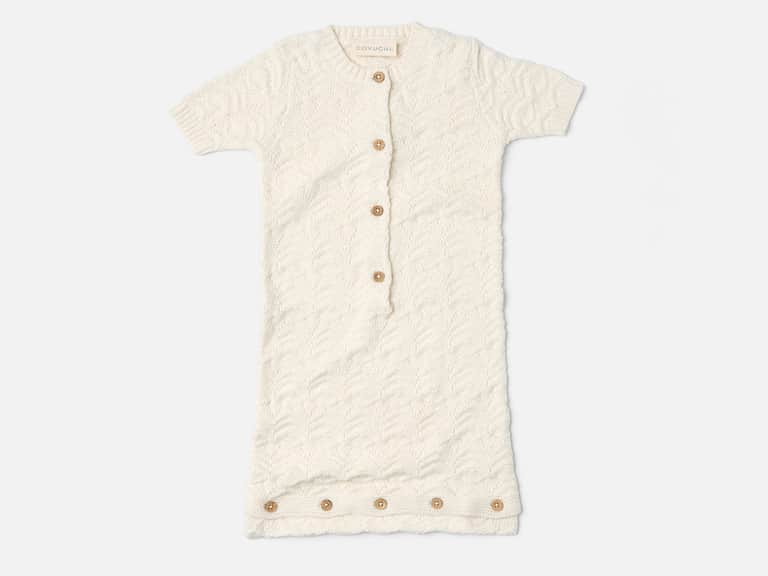
For instance, the Wren Organic Knit Snuggle Sack is described as made with GOTS-certified organic cotton and assembled in a Fair Trade Certified factory in India. Those statements point to two different kinds of information: one concerns the organic-fiber certification named in the product description, while the other identifies a factory-related Fair Trade claim. They should be assessed separately, against the relevant programs’ published requirements and the scope applying to the product. The description alone does not establish that every stage of the cotton supply chain is covered by the factory certification.
This distinction is useful beyond one product or brand. A company may provide detailed origin and material information while still leaving questions about the exact certification scope unanswered. Consumers can recognize the disclosed facts without extending them beyond what the documentation supports. Conversely, the presence of a specific certifier and a clear scope statement makes a claim more meaningful and easier to verify.
When researching Coyuchi bedding or any other textile brand, compare the product page with the certifier’s own information. Check whether the program name is exact, whether a mark or certificate is current, and whether the standard refers to a factory, product, or supply-chain stage. If the brand describes its own policies alongside a certification, keep those two categories separate in your assessment.
Fair Trade, organic, and other textile credentials are not substitutes
Bedding labels often appear together, which can make their purposes blur. A material certification may address fiber production or processing. A Fair Trade-related credential may focus on worker conditions or a particular workplace. A safety or chemical standard may assess restricted substances or testing requirements. Each can contribute useful information, but none should be assumed to verify everything covered by the others.
For example, an organic claim does not automatically establish that workers at a sewing factory are protected by a Fair Trade standard. Likewise, a factory-based Fair Trade certification does not necessarily demonstrate that cotton was grown organically or that every dyeing and finishing process meets a separate environmental standard. Readers should match each claim to the question they want answered.
It can help to make a small “claim map” while comparing products. Write down the label, the organization behind it, what it covers, and what it does not. That simple habit can make a crowded product page easier to interpret and prevent one impressive credential from standing in for several different kinds of evidence.
A balanced view of audits and accountability
Independent assessment can add credibility, but it is not a magic word. The value of an audit depends on the program’s requirements, how assessors are selected and trained, what evidence they review, whether workers can speak freely, how often checks happen, and how problems are handled. Consumers may not have access to every audit report, but they can look for transparent descriptions of the process and the consequences of non-compliance.
Audits also capture conditions at particular times and in particular places. They cannot guarantee that every worker’s experience is identical or that every issue will be detected. Strong programs may combine audits with complaint mechanisms, corrective-action plans, follow-up checks, and other forms of ongoing oversight. The published standard and verification rules explain what is intended; public reporting can help show how that system operates in practice.
For shoppers, the most responsible interpretation is neither cynical nor credulous. A credible, current certification with a defined scope is meaningful evidence. It is not proof of perfection, and it should not be stretched to cover unexamined parts of the supply chain. Taking both points seriously makes ethical shopping more informed and less dependent on marketing language.
A quick checklist for shoppers
Before relying on a Fair Trade claim for bedding, pause and check the essentials:
- Is the certifier named?
- Can you find the program’s current standard?
- Is the scope clear—facility, product, material, or supply-chain stage?
- Does the claim apply to the exact item you are considering?
- Are verification methods and renewal or corrective-action practices explained?
- Are separate claims—such as organic content, worker protections, and chemical controls—supported by the appropriate evidence?
- Does the brand distinguish verified certification from its own goals and commitments?
If several answers are missing, that does not automatically prove a claim is false. It does mean the available information is incomplete, and a shopper should avoid treating it as a comprehensive assurance.
The bottom line
Fair Trade certifications can help consumers understand parts of a bedding supply chain, but the label is only the beginning of the investigation. Programs differ, and their reach may stop at a particular factory, product, or stage of production. The most useful evidence is specific: a named certifier, a published standard, an understandable scope, and current information about how compliance is checked.
When a product page or brand statement leaves those details unclear, ask what is certified and where the certification applies. For bedding shoppers researching Coyuchi or any other brand, that small shift—from “Does it say Fair Trade?” to “What does this particular certification actually verify?”—can make ethical sourcing claims far easier to read. It respects the value of independent standards while keeping expectations grounded in what the evidence truly covers.